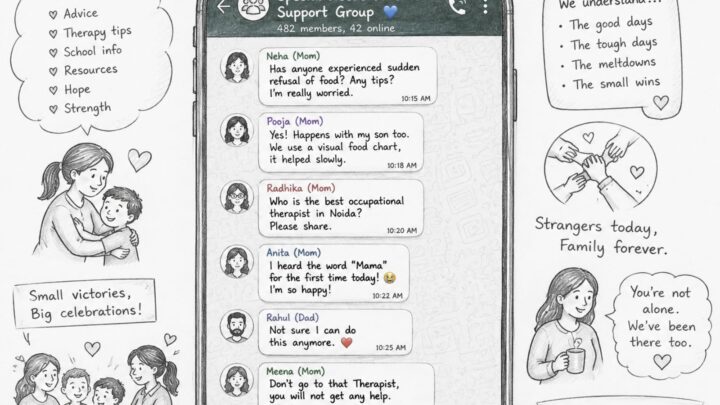
Has anyone experienced sudden refusal of food? Who is the best occupational therapist in Noida?” I heard the word “Mama” for the first time. Not sure I can do this anymore. Don’t go to that Therapist, you will not get any help.
In just minutes, dozens of replies flood in—not from doctors or counsellors—but parents who have been there.
Also Read: How This Autism Father Turned Fear into SafeScan, a QR Code for Child Safety
WhatsApp groups across India are now turning into the strongest assist systems for households elevating children, youngsters with developmental conditions including autism, ADHD, cerebral palsy and Down syndrome. What starts with a handful of people formed after a therapy group or school meeting grows into something much bigger: strangers acting as navigators and cheerleaders, sharing their stories and sometimes becoming friends for life.
In a country that still grapples with costly interventions and unequal access to services in its special need’s ecosystem, it is these digital communities that are bridging a chasm no institution can.
Not just another group chat
A diagnosis of autism and other neurodevelopment disorder can make families feel confused by all the different pieces of advice, as well as mistaken information on the internet. Many parents say they don’t know anyone in their immediate circle who truly understands what they are experiencing.
Also Read: Sensory Need or Behaviour Issue? How to Tell the Difference
That changes when they join a WhatsApp group.
“Due to my daughter’s autism, after her diagnosis it felt like I was lost in a maze chasing an invisible friend. This WhatsApp group changed that. Today it is much more than a chat group, it is like family. Parents share in the joy of every small development, they share hugs on tough days, recommend therapists, schools and resources — and remind one another that no question is a small one. You are taught about how every child is unique and no parent should have to go through this journey alone,” says a mother who runs a whatsapp group of special parents.
The groups are active almost around the clock. Questions range from toilet training and speech delays to inclusive schools, disability certificates, meltdowns in public places and sibling relationships.
Also Read: Can Children Outgrow ADHD or Autism?
One parent wonder if a child refusing to put shoes on could be sensory related; one of them shows a visual schedule that worked at their home; somebody posts a picture of a communication board; a father announces that their child began getting the hair cut done without tantrums for the first time. The celebration belongs to everyone.
There is acknowledgment, not judgment.
Where experience becomes expertise
Many WhatsApp communities are developed with around shared lived experience, as opposed to social media platforms overflowing with unsolicited opinions.
Common description from parents for them is the “Google with empathy”
They know which hospitals have the longest waiting lists, if their therapist has changed clinics, how to apply for a disability certificate, what questions they should ask at an IEP meeting and where to buy sensory-friendly shoes when those ones come off too.
This collective knowledge often saves families months of trial and error.
“The group has supported me more than I could have ever expected. Finding the right therapist, school and employing simple strategies that actually work at home — I have learned more from other parents that have been through this than I could ever learn from therapy sessions.” a parent told the publication.
Studies have likewise determined that WhatsApp support groups offer informational and also emotional assistance, providing moms and dads the choice to share useful techniques while lowering feelings of anxiety and isolation.
Lessons you can’t learn at therapy centre
What parents say is that the best part about these groups isn’t always the advice but the perspective.
Watching another family’s child gradually learn to communicate reminds newly diagnosed parents that progress isn’t linear, but it is possible. They talk about burnout, marital strain in work and parenting life, money worries, guilt and the emotional drain of being an everyday advocate.
It is comforting to read a simple message:
“You’re not failing. We all have days like that.” Those words frequently come at midnight — precisely when they are most needed.
Small victories become everyone’s celebration and in most families, the first time a child says a first word or eats a new food might be considered standard practice.
All victories are celebrated in these squads because everyone knows how hard they are to get.
How Fathers are getting Voice too
Traditionally support groups have been dominated by mothers and that is slowly changing.
Across the world, fathers raising autistic children are also finding connection through online communities, sharing experiences they often struggle to discuss elsewhere. More fathers in India have also started leaving the sidelines to engage on digital platforms, raising questions about behaviour, education and communication.
Not just Friends, but creating an Ecosystem
WhatsApp groups have now extended far beyond of just emotional support. They now organise: Therapy recommendations; Inclusive playdates; Book and toy exchanges; Parent workshops; Awareness sessions on the various Rights of persons with disabilities; School admissions guidance; Fundraisers for families in crisis
An increasing number of structured support groups integrate peer-to-peer interaction with professional facilitation to tap into the acknowledgement that community support has a prominent role in caregiver wellness.
However, it is important to understand that not every message should be interpreted as medical advice. WhatsApp groups too have their limits like any other online community and another parent’s advice may not work for every child.
Also Read: Why The SC’s Intervention On Therapy Centres Could Be A Turning Point For Special Children
Experts caution that decisions regarding therapy, whether to adjust medications or dietary interventions should be driven by consultation with qualified professionals — not adopted simply because it worked for any other family.
This is a very important distinction, and the healthiest communities understand it.
Today’s parents of children with disabilities are building a new village – one that lives in a smartphone. It doesn’t prepare your meals, nor does it help you watch kids. However, it provides answers to 2 AM questions, it celebrates milestones nobody else pays attention to and a reminder to frazzled parents that lots of them are not alone.
In a world where therapy is expensive and understanding is often scarce, perhaps the most meaningful notification isn’t from a hospital or a school.
It’s the quiet buzz of a WhatsApp message saying: “We’ve been there too. You’ll get through this.”