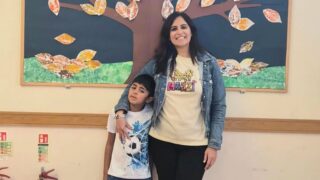

For many parents, a child’s first word is something they live for, it’s something they hope for and something they question everything for. Speech-Language Pathologist and Audiologist Monika Suresh, 30 years, from Coimbatore, is a proud and passionate member of the community who knows what it takes to help people, especially the children, with all sorts of communication disorders. Starting from her close friend’s family member diagnosis with hearing loss, she got exposed to the field of audiology, rehabilitation and speech-language pathology.
She did her BASLP and Master’s in Speech-Language Pathology from Bangalore University and started her professional journey in the field in the year 2019. She started her practice from teletherapy during the pandemic. With the experience of Oral Placement Therapy, apraxia, speech and swallow, she was honoured to receive the 2026 SIWAA Excellence in Medical Services Award. As a Speech-Language Pathologist and Audiologist, she wants to make a difference, help from the roots and work collaboratively to make the life of special need children more result and goal oriented.
Also Read: Prashant Issar’s Ishaara: A Restaurant Where Communication Goes Beyond Words
In an exclusive interaction with All About Inclusive, Monika Suresh, shares light on the things parents wish they knew while navigating their little one’s way through mixed feelings, excitement, confusion, and loads of hope. From understanding ways of communicating with a child without words to cutting out parental guilt and learning the value of a word to a parent, she answers all.

Question 1) When a child is not speaking, parents often hear a hundred opinions before they hear the one thing they really need understanding. What do you wish every worried parent knew?
Answer: One thing I have learned through years of working with families is that parents’ instincts matter. Deep inside, every parent wants to hear something positive “He will speak,” “Boys speak late,” “Give him some time,” or “Someone in our family spoke late too.” That hope is completely natural, but reassurance should not delay seeking clarity when a parent genuinely feels concerned. I always tell parents not to compare their child’s journey with another child’s. Instead of only asking, “When will my child talk?” ask, “What is making communication difficult for my child, and what support does my child need right now?”
Early assessment is not about labelling or forcing speech. It is about trusting your parental instinct, understanding your child’s strengths and needs, and providing the right support at the right time.
Also Read: Autism & Occupational Therapy: Dr. Manish Samnani of SOCH on What Parents Often Miss
Question) What is the one moment in your journey as a speech therapist that made you realise therapy is not just about helping a child communicate, but also about healing a parent’s fears?
Answer: This realization came very early in my journey, when I was in my second year of undergraduate studies. During my clinical posting, I met a mother whose child had significant developmental challenges. After my seniors had explained the child’s condition and therapy need, she looked at me and asked just one question: “Will my child ever call me Amma?” That question stayed with me. Beyond all the clinical information, she needed someone to listen to her fears, educate her, and help her understand her child and what the journey ahead might look like.
Years later, I happened to meet the family again. The child had made beautiful progress, but what touched me equally was how much the mother had grown through the journey. There were more understanding, acceptance and confidence in the way she spoke about her child. That experience shaped something I strongly believe even today: Therapy is not only about the child’s growth. Parents grow through the journey too. Our responsibility is to listen, educate and empower them to understand their child’s strengths and needs, because when a parent understands their child better, the support continues far beyond the therapy room.
Question) For a parent waiting to hear their child say “Mama” or call them for the first time, how do you explain that communication can begin long before words do?
Answer: For many parents, that first “Mama” is not just a word it carries so much emotion, and I completely understand why they wait for it. But one thing I often help parents see is that their child may already be communicating with them, even before words appear. It may be through a look, pulling a parent towards something, reaching out, pointing, a gesture, a sound, or bringing something over just to share it. These small moments tell us something very important: “I have something to tell you.”
So rather than making the spoken word our only measure of progress, I encourage parents to recognise, respond to and build on every meaningful attempt to connect. I often say, “While you are waiting to hear ‘Mama,’ don’t miss the many ways your child may already be calling you.” For me, that is where communication truly begins and words can be built upon that Foundation.
Also Read: She Spent 34 Years Trying to Fix Herself Then Autism Gave Her the Answers
Question) Many parents secretly blame themselves when their child has a speech delay. What would you say to the mother or father lying awake at night wondering, “Did I do something wrong?”
Answer: Every parent is different, and every family processes their child’s journey differently. But one emotion I have seen very commonly is guilt. Parents go back through pregnancy, screen time, work schedules, parenting choices almost everything wondering, “Did I do something wrong?”
I try to help them understand that speech and language development is complex, and there is rarely one single factor responsible for a delay. Rather than remaining stuck in “What did I do wrong?”, I encourage them to ask, “What does my child need from me now?”
I strongly believe parents should be active participants in the therapeutic journey, not just people waiting outside the therapy room. When parents understand their child’s strengths and need and know how to support communication in everyday life, I have seen that guilt gradually transform into understanding, involvement and confidence.
Question) Behind every milestone is often a parent who has cried, worried and almost given up. Can you share a moment when a child’s small progress meant something much bigger to their family?
Answer : There have been many moments like this over the years, where what seems like a small achievement to others means everything to a family. I remember a child who had very few spoken words. We introduced AAC – a communication system that helps a child express themselves using pictures or a device. Initially, the parents were unsure about it because naturally, they were waiting and hoping to hear their child speak. One day, the child used the device independently to tell the parent what they wanted.
Until then, the family often had to guess, Is the child hungry? Do they want something? Are they uncomfortable? But that day, the child could tell them.
The parent became emotional. It may have looked like a simple selection on a screen, but for that family, it was the first experience of “I don’t have to guess anymore. My child can tell me.” That moment is something I often remember because communication is not only about spoken words. It is about giving a child a way to be heard and understood.
Question) Do you think parents sometimes become so focused on making their child speak that they forget to listen to the many ways their child may already be trying to communicate?
Answer: Yes, I see this quite often, and it usually comes from a genuine desire to hear their child speak. When parents are worried about speech, everyday interactions can slowly become filled with “Say this,” “What is this?”, “Tell me,” or “Repeat after me.” Without realising it, communication can start feeling like a test rather than a connection. I encourage parents to observe more, pause more and follow their child’s lead. Look for skills such as joint attention when a child looks at something and then back at you, brings something to show you, or simply wants you to share an experience with them. These moments may seem small, but they are important foundations for communication.
Also Read: Her Speech Was Delayed, Not Her Potential: Story Of 10-year-old Sanvika
Sometimes, when we ask less and give the child more space to initiate, we begin to see much more of what they are actually trying to communicate. For me, successful communication is not simply about producing more words. It is about communication becoming meaningful, spontaneous and enjoyable for the child. Sometimes teaching a parent when to wait, observe and listen is just as important as teaching them what to say.
Question) Years from now, when parents look back at the difficult days of therapy, delayed milestones and uncertainty, what do you hope they will remember about their child’s journey and about themselves?
Answer: Years from now, I hope parents don’t remember this journey only through delayed milestones, therapy appointments or the things their child couldn’t do at a particular age. I hope they remember the small victories that once felt enormous and all those little steps that slowly added up. I also hope they remember how much they grew alongside their child. Along the way, many parents find people who truly
understand them, build beautiful friendships with other families, and realise that they were never walking this journey alone. There may have been days of fear, comparison, exhaustion and uncertainty, but there were also moments of connection, celebration, new friendships and unexpected strength.
Most importantly, I hope that when they look back, they see not just how far their child has come, but how far they themselves have come too learning, adapting, understanding and growing together with their child.