
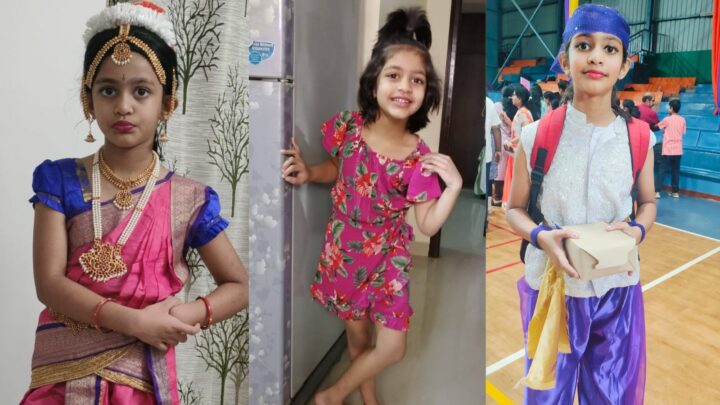
If we are open to listening, a child’s silence can often speak louder than words. Ten-year-old Sanvika from Bengaluru was sometimes thought to have autism because of her speech and language delays, making it difficult for her to get the kind of support she deserves at school. A child, who was diagnosed with ‘Development Language Delay’ , was quietly processing the world in her own way.
Sanvika has demonstrated that intelligence cannot be measured by communication alone. She taught herself to ride a bicycle, swim and play the piano, while also displaying a remarkable grasp of numbers. Her story serves as a powerful reminder that every child deserves tolerance, opportunity, and compassion—and that a child’s speech delay should never be used as a barometer for their potential.
Her mother, Meena Ganugapati, talks about how she saw Sanvika’s potential, battled for school opportunities, and learned to look beyond what her daughter could-or could not-say.

1) Sanvika is exceptionally gifted in mathematics, yet her speech and language delays led people to assume she was autistic. What was your family’s experience of this journey, and how did you realise that her abilities were being overlooked?
We went to different therapy centers for therapy, and everyone told us that she could do all the activities very easily and that she needed only speech therapy. However, they came to this conclusion only after a few months of sessions.
Also Read: Genital Stimming in Autism: Dr. R. S. Bagga Explains the Behaviour
She learnt to ride a bicycle without supporting wheels by herself. She learnt to play the piano on her own, and she also learnt to swim by herself. Seeing all this, we started wondering, “Why can’t she learn numbers and alphabets?” As a mother, it took me some time to teach her the initial alphabets and numbers. I did not realise that she had already understood and mastered so much. She did not always show me how much she knew.
Then, one day, she started telling me big numbers and identifying which numbers were bigger and smaller. That was when we realised that she was processing things at a much faster pace.
It has not been a simple journey, but we are very happy and grateful for her extraordinary ability.
2) When did you first recognise that Sanvika had an extraordinary gift for mathematics, and what were some of the moments that made you realise she was thinking far beyond her age?
When she was seven years old, she used to sit with me and her sister while I taught my elder daughter maths. Sanvika started telling me all the answers. She could also answer multiplication tables, square roots and cube roots.
I had taught her only the concepts of multiplication and division, so I still did not believe it.
One day, I read out a small word problem, and she whispered the correct answer. That was the moment I realised that she could understand the language of the problem as well. Her ability has continued to surprise us. Recently, we started giving her word problems from the CBSE Class 10 Mathematics syllabus. We asked her one question from each chapter, and we have also posted these questions and her answers on Instagram.
What amazed us was that we had not formally taught her any of these Class 10 chapters. Her sister, Sahasra, is currently in Class 10, so it is possible that Sanvika may have overheard some of these concepts when I was teaching her sister last year. But we had never sat with Sanvika and taught her these chapters.
Also Read: Mud, Grass, Water or Noise: Understanding Sensory Needs in Autism and ADHD
Even so, when we asked her the questions, she was able to solve them almost instantly in her head. This included problems involving quadratic equations, polynomials, trigonometry, heights and distances, volumes, geometry and different shapes, along with problems from the other Class 10 CBSE chapters.
She did not need us to work through the problems with her or explain the steps first. She would listen to the question, process it in her mind and give us the answer.
For us, that was one of the clearest indications of how remarkably she processes mathematical concepts. It was not just that she knew a formula; she was able to understand the problem and arrive at the answer mentally and almost immediately. That was when I became even more certain that she has exceptional mathematical talent.
3) How difficult has it been to convince schools that a child with speech and language delays can also be academically capable—and what do you wish educators understood about Sanvika?
Sanvika was always an independent child, but because of her speech delays, people often thought that it would be difficult to manage her in a school setting. People often assume that a speech delay means that a child has either ASD or ADHD.
After multiple rounds of meetings with the principal, she finally agreed to give Sanvika a seat with the support of a shadow teacher. As a child with language delay, it is very difficult for her when people speak too fast. Writing notes is also difficult for her. When people understand her needs better, she is able to learn and respond much more effectively.
We are still not completely happy because the school does not recognise or encourage her abilities enough.
I feel educators need to guide parents on how to help children become independent in education. Many therapy centers focus on therapy, but parents also need guidance on how to make their children independent.
My child answers math questions when I am there with her. She will not even answer her dad(Nowadays she started answering). Why she does not answer certain people is something educators need to understand rather than simply assume that she cannot answer. Schools should have a proper support system within the school premises. Not everyone can afford a shadow teacher. If schools themselves can provide this kind of support, it would benefit every child who needs it.
Also Read: Can Nature Be a ‘Therapy’ for Autism, ADHD? What New Research Says
4) You have often had to step in and create opportunities for Sanvika when the support she needed wasn’t available. How did you turn from being her mother into becoming one of her strongest advocates and mentors?
In this case, I literally begged schools to give her opportunities. I realized that unless I, as a mother, understood and guided my kid, no one else would understand her. I started reading many articles online and trying different approaches to understand her better and support her learning.
My love for my daughter, along with my concern about how she would manage in a world that may not always understand her, made me want to become her mentor. I wanted to prepare her for the world, teach her to be independent and make sure she would be able to stand on her own.
5) What has Sanvika taught you about the danger of judging a child’s intelligence by how well they speak or communicate?
She never hesitated to try anything new. For example, when her sister learnt to ride a bicycle, Sanvika would think, “Why can’t I?” She had the same attitude towards swimming, singing, playing the piano, drawing and many other things.
Her attitude made me realise that one small difficulty cannot make anyone any less capable. That is what I learnt from my child: when someone has talent and the determination to learn, no one can stop them.
6) As a mother raising Sanvika alongside her sibling in Bengaluru, how have you balanced her needs, her talents and the dynamics of family life?
I must say that my elder daughter is a blessing in my life. She saw me struggle while raising Sanvika and always encouraged me. She would say, “Amma, please take care of her. She needs you more than me.” Mom guilt used to affect me deeply, but my husband was always very encouraging. He made sure to take care of my elder daughter and supported me throughout this journey.
The only thing I sacrificed was my career for my children. When I am tired, my elder daughter takes care of Sanvika like a mother. Many of Sanvika’s achievements are because of her sister, Sahasra.
7) If you could change one thing about how schools and society respond to children with speech and language delays, what would you want them to understand—and what do you hope Sanvika’s story will change for other children like her?
Never judge a child by their ability to communicate. Not every child is able to communicate by the age of three. Some children take more time to learn to speak.
Please do not think that the mother or father has done something wrong or that they are somehow responsible for the child’s difficulties. And please do not make insensitive comments such as, “God knows you are capable of handling the stress. If I were in your situation, I could not handle it.”
Also Read: Is Vaccine Really Linked to Autism: Doctors Explain Trump’s Claims
I want people to understand that situations teach us how to handle difficult things. We are not necessarily born knowing how to deal with every challenge. If you love your children, you can do anything for them. Please give every child opportunities, irrespective of the difficulties they may have.
Schools should have proper support systems, and mothers should be allowed to support their children at school when necessary. Last but not least: “Not every child with speech delay has autism. Don’t simply tag kids with Autism and ADHD.”
Practice and opportunity matter for everyone. Please don’t give up on these children. Encourage them. As elders, it is our duty to teach neurotypical children to understand that children with difficulties are no less than anyone else.c